A shopping mall, shopping centre, shopping arcade, shopping precinct or simply mall is one or more buildings forming a complex of shops representing merchandisers, with interconnecting walkways enabling visitors to easily walk from unit to unit, along with a parking area — a modern, indoor version of the traditional marketplace.
Modern "car-friendly" strip malls developed from the 1920s, and shopping malls corresponded with the rise of suburban living in many parts of the Western World, especially the United States, after World War II. From early on, the design tended to be inward-facing, with malls following theories of how customers could best be enticed in a controlled environment. Similar, the concept of a mall having one or more "anchor" or "big box" stores was pioneered early, with individual stores or smaller-scale chain stores intended to benefit from the shoppers attracted by the big stores.
most of the world the term shopping centre is used, especially in Europe, Australasia and South America; however shopping mall is also used, predominantly in North America[2] and the Philippines. Outside of North America, shopping precinct and shopping arcade are also used. In North America, the term shopping mall is usually applied to enclosed retail structures (and is generally abbreviated to simply mall), while shopping center usually refers to open-air retail complexes; both types of facilities usually have large parking lots, face major traffic arterials and have few pedestrian connections to surrounding neighborhoods.[2] 
Shopping arcade in Tokyo, Japan
Shopping centres in the United Kingdom can be referred to as "shopping centres", "shopping precincts", or "town centres". The standard British pronunciation of the word "mall" rhymes with "pal", as in "The Mall, London" – the tree-lined avenue leading to Buckingham Palace, London. Mall can refer to either a shopping mall – a place where a collection of shops all adjoin a pedestrian area – or an exclusively pedestrianised street that allows shoppers to walk without interference from vehicle traffic. Mall is generally used in North America to refer to a large shopping area usually composed of a single building which contains multiple shops, usually "anchored" by one or more department stores surrounded by a parking lot, while the term arcade is more often used, especially in Britain, to refer to a narrow pedestrian-only street, often covered or between closely spaced buildings (see town centre). A larger, often partly covered and exclusively pedestrian shopping area is in Britain also termed a shopping centre, shopping precinct, or pedestrian precinct.
The majority of British shopping centres are located in city centres, usually found in old and historic shopping districts and surrounded by subsidiary open air shopping streets. Large examples include the Manchester Arndale, Bullring Birmingham, Liverpool One, Buchanan Galleries in Glasgow and Eldon Square in Newcastle upon Tyne. In addition to the inner city shopping centres, large UK conurbations will also have large out-of-town "regional malls" such as Meadowhall, Sheffield serving South Yorkshire, the Trafford Centre in Greater Manchester and Bluewater in Kent. These centres which were built in the 1980s and 1990s, but planning regulations prohibit the construction of any more. Out-of-town shopping developments in the UK are now focused on retail parks, which consist of groups of warehouse style shops with individual entrances from outdoors. Planning policy prioritizes the development of existing town centres, although with patchy success. The MetroCentre, in Gateshead (near Newcastle upon Tyne), is the largest shopping centre in Europe with over 330 shops, 50 restaurants and an 11 screen cinema and Westfield London is the largest inner-city shopping centre in Europe. Bullring, Birmingham is the busiest shopping centre in the UK welcoming over 36.5 million shoppers in its opening year.[3]

Cabot Circus in Bristol city centre, England
In Hong Kong, the term "shopping centre" is the most frequently used, and the name of a shopping centre in Hong Kong usually contains the word "centre" or "plaza". The same is true for Portuguese-speaking Brazil, though with American spelling "shopping center".
History
The first structure resembling what is considered to be a "shopping mall" in the present-day is located in The City of Damascus, the capital city of Syria. It is called Al-Hamidiyah Souq in old Damascus and dates back to the 19th century.[4] Isfahan's Grand Bazaar, which is largely covered, dates from the 10th century. The 10 kilometer long covered Tehran's Grand Bazaar also has a long history. The Grand Bazaar of Istanbul was built in the 15th century and is still one of the largest covered markets in the world, with more than 58 streets and 4,000 shops.
Gostiny Dvor in St. Petersburg, which opened in 1785, may be regarded as one of the first purposely-built mall-type shopping complexes, as it consisted of more than 100 shops covering an area of over 53,000 m2 (570,000 sq ft).
The Oxford Covered Market in Oxford, England opened in 1774 and still runs today.
The Burlington Arcade in London was opened in 1819. The Arcade in Providence, Rhode Island introduced the retail arcade concept to the United States in 1828. This was a forerunner of today's shopping mall [5] The Galleria Vittorio Emanuele II in Milan, Italy followed in the 1870s and is closer to large modern malls in spaciousness. Other large cities created arcades and shopping centres in the late 19th century and early 20th century, including the Cleveland Arcade, Dayton Arcade and Moscow's GUM, which opened in 1890. Early shopping centers designed for the automobile include Market Square, Lake Forest, Illinois (1916) and Country Club Plaza, Kansas City, Missouri (1924).
An early indoor mall prototype in the United States was the Lake View Store at Morgan Park, Duluth, Minnesota, which was built in 1915 and held its grand opening on July 20, 1916. The architect was Dean and Dean from Chicago and the building contractor was George H. Lounsberry from Duluth. The building is two stories with a full basement, and shops were originally located on all three levels. All of the stores were located within the interior of the mall; some shops were accessible from inside and out.
In the mid-20th century, with the rise of the suburb and automobile culture in the United States, a new style of shopping centre was created away from downtown.[6]

The "Sevens" shopping mall in Düsseldorf, Germany.
Early examples
The Cleveland Arcade was among the first indoor shopping arcades in the US and an architectural triumph. When the building opened in 1890, two sides of the arcade had 1,600 panes of glass set in iron framing and is a prime example of Victorian architecture.
An early shopping center in the United States was Country Club Plaza, which opened in 1923 in Kansas City, Missouri. Other important shopping centers built in the 1920s and early 1930s are the Highland Park Village in Dallas, Texas; River Oaks in Houston, Texas; and Park and Shop in Washington, D.C..
The suburban shopping mall, as Americans -and the world- came to know it, debuted in King County (Seattle), Washington in April 1950. Originally known as Northgate Center (now as Northgate Mall), it was an open-air complex of eighty stores and services, anchored by a Seattle-based The Bon Marche. This idea was quickly copied in several American cities, such as with Lakewood Center (1951), in Lakewood, California, Shoppers' World (1951), in Framingham, Massachusetts, Stonestown Center (now Stonestown Galleria) (1952) in San Francisco, California and Northland Center (1954), in Southfield, Michigan. Open-air-type malls were also built in Canada and Australia. Don Mills Convenience Centre (now Shops at Don Mills) opened in 1955, in Toronto, Ontario. Chermside Drive-In Shopping Centre, started trading to the public in 1957, in Brisbane, Australia.
The fully enclosed shopping mall did not appear until the mid-1950s. The idea of a regional-sized, fully enclosed shopping complex was pioneered in 1956 by the Austrian-born architect and American immigrant Victor Gruen.[7] This new generation of regional-sized shopping centers began with the Gruen-designed Southdale Center, which opened in the Twin Cities suburb of Edina, Minnesota, USA in October 1956. For pioneering the soon-to-be enormously popular mall concept in this form, Gruen has been called the "most influential architect of the twentieth century".[1]
The first retail complex to be promoted as a "mall" was Paramus, New Jersey's Bergen Mall. The center, which opened with an open-air-format in 1957, was enclosed in 1973. Aside from Southdale Center, significant early enclosed shopping malls were Harundale Mall (1958), in Glen Burnie, Maryland, Big Town Mall (1959), in Mesquite, Texas, Chris-Town Mall (1961), in Phoenix, Arizona, and Randhurst Center (1962), in Mount Prospect, Illinois.
The first fully enclosed shopping mall in Canada was Wellington Square Mall, which was designed for Eaton's by John Graham Jr. as an enclosed mall with a department store anchor and subterranean parking.[8] It opened in downtown London, Ontario, on August 11, 1960. After several renovations, it remains open today as Citi Plaza.[8]
Other early malls moved retailing away from the dense, commercial downtowns into the largely residential suburbs. This formula (enclosed space with stores attached, away from downtown, and accessible only by automobile) became a popular way to build retail across the world. Gruen himself came to abhor this effect of his new design; he decried the creation of enormous "land wasting seas of parking" and the spread of suburban sprawl.[1][9]
In the UK, Chrisp Street Market was the first pedestrian shopping area built with a road at the shop fronts. Developers such as Alfred Taubman of Taubman Centers extended the concept further, with terrazzo tiles at the Mall at Short Hills in New Jersey, indoor fountains, and two levels allowing a shopper to make a circuit of all the stores.[10] Taubman believed carpeting increased friction, slowing down customers, so it was removed.[10] Fading daylight through glass panels was supplemented by gradually increased electric lighting, making it seem like the afternoon was lasting longer, which encouraged shoppers to linger.[11][12]
Ala Moana Center in Honolulu, Hawaii is currently the largest open-air mall in the world and was one of the largest malls in the United States when it opened for business in August 1959. It is currently the sixteenth largest in the country. The Outlets at Bergen Town Center, the oldest enclosed mall in New Jersey, opened in Paramus on November 14, 1957, with Dave Garroway, host of The Today Show, serving as master of ceremonies.[13] The mall, located just outside New York City, was planned in 1955 by Allied Stores to have 100 stores and 8,600 parking spaces in a 1,500,000 sq ft (139,000 m2) mall that would include a 300,000 sq ft (28,000 m2) Stern's store and two other 150,000 sq ft (14,000 m2) department stores as part of the design. Allied's chairman B. Earl Puckett confidently announced The Outlets at Bergen Town Center as the largest of ten proposed centers, stating that there were 25 cities that could support such centers and that no more than 50 malls of this type would ever be built nationwide.[14][15]

Amusement park at the center of the Mall of America in Bloomington, Minnesota, the largest shopping mall in the United States
Largest examples
The largest mall ever is South China Mall in Dongguan, China with gross floor area of 892,000 m2 (9,600,000 sq ft). The world's second-largest shopping mall is the Golden Resources Mall in Beijing, China with gross floor area of 680,000 m2 (7,300,000 sq ft). The SM City North EDSA in the Philippines, which opened in November 1985, is the world's third-largest at 460,000 m2 (5,000,000 sq ft) of gross floor area, and SM Mall of Asia in the Philippines, opened in May 2006, is the world's fourth largest at 386,000 m2 (4,150,000 sq ft) of gross floor area.
Previously, the title of the largest enclosed shopping mall was with the West Edmonton Mall in Edmonton, Alberta, Canada from 1986–2004. It is now the fifth largest mall.[16] Dubai Mall is the largest mall in Middle East, currently ranked seventh in the world. The current largest shopping centre in Europe is the Dolce Vita Tejo in Lisbon, Portugal, while the largest in Australia is Chadstone Shopping Centre in Melbourne.[17]
One of the world's largest shopping complexes in one location is the two-mall agglomeration of the Plaza at King of Prussia and the Court at King of Prussia in the Philadelphia suburb of King of Prussia, Pennsylvania, United States. The King of Prussia mall has the most shopping per square foot in the U.S.
The most visited shopping mall in the world and largest mall in the United States is the Mall of America, located near the Twin Cities in Bloomington, Minnesota. However, several Asian malls are advertised as having more visitors, including Mal Taman Anggrek, Kelapa Gading Mall and Pluit Village, all in Jakarta, Indonesia, Berjaya Times Square in Malaysia and SM Megamall in Metro Manila, Philippines. The largest mall in South Asia is Mantri Square in Bangalore, India.[citation needed]
Classes
In many cases, regional and super-regional malls exist as parts of large superstructures which often also include office space, residential space, amusement parks and so forth. This trend can be seen in the construction and design of many modern supermalls such as Cevahir Mall in Turkey. The International Council of Shopping Centers' 1999 definitions[18] were not restricted to shopping centers in any particular country, but later editions were made specific to the U.S. with a separate set for Europe.
[edit] Regional
A regional mall is, per the International Council of Shopping Centers, in the United States, a shopping mall which is designed to service a larger area (15 miles) than a conventional shopping mall. As such, it is typically larger with 400,000 sq ft (37,000 m2) to 800,000 sq ft (74,000 m2) gross leasable area with at least two anchor stores[19] and offers a wider selection of stores. Given their wider service area, these malls tend to have higher-end stores that need a larger area in order for their services to be profitable but may have discount department stores. Regional malls are also found as tourist attractions in vacation areas.[19]
Super regional
A super regional mall is, per the International Council of Shopping Centers, in the U.S. a shopping mall with over 800,000 sq ft (74,000 m2) of gross leasable area, three or more anchors, mass merchant, more variety, fashion apparel, and serves as the dominant shopping venue for the region (25 miles) in which it is located.[19]
Outlet
Main article: Outlet mall
An outlet mall (or outlet centre) is a type of shopping mall in which manufacturers sell their products directly to the public through their own stores. Other stores in outlet malls are operated by retailers selling returned goods and discontinued products, often at heavily reduced prices. Outlet stores were found as early as 1936, but the first multi-store outlet mall, Vanity Fair, located in Reading, PA did not open until 1974. Belz Enterprises opened the first enclosed factory outlet mall in 1979, in Lakeland, TN, a suburb of Memphis.[20]
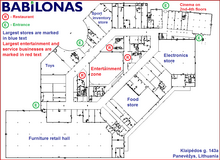
The layout of a mid-sized shopping center Babilonas in Panevėžys, Lithuania (with main stores marked in text). Entertainment zone is in the center surrounded by restaurants, whereas the anchor stores are in different sides of the center.
Cinema is in the floors above. The corridor is circular and there are no shortcuts (so a customer has to go around the mall to go to a shop on a different side).
Components
Food court
Main article: Food court
A common feature of shopping malls is a food court: this typically consists of a number of fast food vendors of various types, surrounding a shared seating area.[citation needed]
Department stores
Main articles: Department store and Anchor store
When the shopping mall format was developed by Victor Gruen in the mid-1950s, signing larger department stores was necessary for the financial stability of the projects, and to draw retail traffic that would result in visits to the smaller stores in the mall as well. These larger stores are termed anchor store or draw tenant. In physical configuration, anchor stores are normally located as far from each other as possible to maximize the amount of traffic from one anchor to another.[citation needed]
[edit] Stand-alone stores
Frequently, a shopping mall or shopping center will have satellite buildings located either on the same tract of land or on one abutting it, on which will be located stand-alone stores, which may or may not be legally connected to the central facility through contract or ownership. These stores may have their own parking lots, or their lots may interconnect with those of the mall or center. The existence of the stand-alone store may have been planned by the mall's developer, or may have come about through opportunistic actions by others, but visually the central facility – the mall or shopping center – and the satellite buildings will often be perceived as being a single "unit", even in circumstances where the outlying buildings are not officially or legally connected to the mall in any way.[citation needed]
Dead malls
Main article: Dead mall

Belz Factory Outlet Mall, an abandoned shopping mall in Allen, Texas, United States
In the U.S, as more modern facilities are built, many early malls have become abandoned, due to decreased traffic and tenancy. These "dead malls" have failed to attract new business and often sit unused for many years until restored or demolished. Interesting examples of architecture and urban design, these structures often attract people who explore and photograph them. This phenomenon of dead and dying malls is examined in detail by the website Deadmalls.com, which hosts many such photographs, as well as historical accounts. Until the mid-1990s, the trend was to build enclosed malls and to renovate older outdoor malls into enclosed ones. Such malls had advantages such as temperature control. Since then, the trend has turned and it is once again fashionable to build open-air malls. According to the International Council of Shopping Centers, only one new enclosed mall has been built in the United States since 2006.[21]
Some enclosed malls have been opened up, such as the Sherman Oaks Galleria. In addition, some malls, when replacing an empty anchor location, have replaced the former anchor store building with the more modern outdoor design, leaving the remainder of the indoor mall intact.
New trends
In parts of Canada, it is now rare for new shopping malls to be built. The Vaughan Mills Shopping Centre, opened in 2004, and Crossiron Mills, opened in 2009, are the only malls built in Canada since 1992. Outdoor outlet malls or big box shopping areas known as power centres are now favored, although the traditional enclosed shopping mall is still in demand by those seeking weather-protected, all-under-one-roof shopping. In addition the enclosed interconnections between downtown multi story shopping malls continue to grow in the Underground city of Montreal (32 kilometres of passageway), the PATH system of Toronto (27 km (17 mi) of passageway) and the Plus15 system of Calgary (16 km (9.9 mi) of overhead passageway).
Vertical malls
High land prices in populous cities have led to the concept of the "vertical mall," in which space allocated to retail is configured over a number of stories accessible by elevators and/or escalators linking the different levels of the mall. The challenge of this type of mall is to overcome the natural tendency of shoppers to move horizontally and encourage shoppers to move upwards and downwards.[22] The concept of a vertical mall was originally conceived in the late 1960s by the Mafco Company, former shopping center development division of Marshall Field & Co. The Water Tower Place skyscraper, Chicago, Illinois, was built in 1975 by Urban Retail Properties. It contains a hotel, luxury condominiums, and office space and sits atop a block-long base containing an eight-level atrium-style retail mall that fronts on the Magnificent Mile.[citation needed]
Vertical malls are common in densely populated conurbations such as Hong Kong and Bangkok. Times Square in Hong Kong is a principal example.[22]

The Fashion Centre at Pentagon City, in
Arlington, Virginia, United States
A vertical mall may also be built where the geography prevents building outward or there are other restrictions on construction, such as historical buildings or significant archeology. The Darwin Shopping Centre and associated malls in Shrewsbury, UK, are built on the side of a steep hill, around the former outer walls of the nearby medieval castle;[23] consequently the shopping centre is split over seven floors vertically – two locations horizontally – connected by elevators, escalators and bridge walkways.[24] Some establishments incorporate such design into their layout, such as Shrewsbury's McDonalds restaurant, split into four stories with multiple mezzanines which feature medieval castle vaults – complete with arrowslits – in the basement dining rooms.
Shopping property management firms
See also: Category:Shopping property management firms.
A shopping property management firm is a company that specializes in owning and managing shopping malls. Most shopping property management firms own at least 20 malls. Some firms use a similar naming scheme for most of their malls; for example, Mills Corporation puts "Mills" in most of their mall names and SM Prime Holdings of the Philippines puts "SM" in all of their malls, as well as anchor stores such as SM Department Store, SM Appliance Center, SM Hypermarket, SM Cinema, and SM Supermarket. In the UK, The Mall Fund changes the name of any centre they buy to "The Mall (location)", using their pink-M logo; when they sell a mall it reverts to its own name and branding, such as the Ashley Centre in Epsom.[25]
Shopping Center Management and advisory firms are bringing about professional management practices to the largely fragmented shopping center development industry in India . In India historically land ownership has been fragmented and as a byproduct Shopping Center Development, which rendered the Single Mall developers vulnerable to dubious advice and practices, as Standard Benchmarks , knowledge resources and skilled people were scarce. This is changing as new firms promoted by former Shopping Center Managers are stepping in to bridge the Gap between Ownership and Professional Management- firms like Squarefeet Consulting,Property Zone, Beyond Squarefeet, Lotuspi Mall advisory, Delta One mall management promoted by T Anupam and Amaan Fakih(former Shopping Center Directors), MSquare Mall management, Lighthouse are leading the way .
New towns
Many new towns in the United Kingdom – including Livingston, Cumbernauld, Glenrothes, East Kilbride, Milton Keynes, Washington, Coventry, Newton Aycliffe, Peterlee and Telford – did not incorporate a traditional style town centre but instead developed a shopping centre. Unlike the shopping centres which were developing in established towns and cities, these also contained many civic functions and other community facilities such as libraries, pubs and community centres. As the towns grew, other facilities were usually developed around the centres, effectively enlarging the town centres.[citation needed]

Westfield Carousel, in a suburb of Perth, Australia
Legal issues
One controversial aspect of malls has been their effective displacement of traditional main streets. Many consumers prefer malls, with their spacious parking garages, entertaining environments, and private security guards, over CBDs or downtowns, which frequently suffer from limited parking, poor maintenance, and limited police coverage.[26][27]
In response, a few jurisdictions, notably California, have expanded the right of freedom of speech to ensure that speakers will be able to reach consumers who prefer to shop, eat, and socialize within the boundaries of privately owned malls
www.wikipedia.org


 Developed very ingeniously and aesthetically by the TDI Group, the TDI Mall commands four spacious floors beside two basement levels for parking and other services. The paramount attraction of the mall is the giant atrium, with all the shops opening to it. This TDI Mall provides ample and lavish facilities for a satisfying shopping experience and exotic dinning satiety. There are many solicitous multi-cuisine restaurants including the Pizza Hut, Subway and Ruby Tuesday, besides a hospitable food court in this glamorous and popular mall of the west Delhi.